









The collaboration between Magic: The Gathering and Final Fantasy is a huge celebration for fans of both games, especially Final Fantasy fans, who can find their favorite characters and the most iconic moments of the franchise in the cards of the set.
In addition to the illustrations, other ways to immerse yourself in the Final Fantasy universe with Magic is through the abilities of the cards: the design team was meticulous in planning most of them to have some coherent representation with the universe of the games — be it through memes, abilities, costs, or keywords.
As a lover of both universes, Final Fantasy has become my favorite Magic: The Gathering set, and one of the main reasons is how much the rich lore of the main FF games managed to find space in the set. As part of the celebration, I chose the ten best Final Fantasy cards that assertively represented some remarkable moment or element of the game.
We would like to point out that only cards from Commander decks made it onto this list. We have an article with the cards from the main set, but with the decks being more segmented in a single game, they open up many opportunities for the four titles that other FFs didn't have in the main set, and putting them all together would not only be disproportionate to the rest, but would also close the space for us to address some illustrations from reprints.
Speaking of reprints, new cards took priority, but some scenes were so well recorded in reprints that they deserve to be mentioned, or even top the list.
Honorable Mention - Relic of Legends
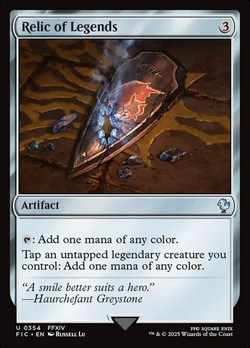
This flavor text broke my heart.
10 - Rise of the Dark Realms

The Final Fantasy VI Commander deck is based on the World of Ruin arc, where Celes and Terra gradually reunite with the other party members to oppose Kefka, Court Mage.
Despite being a reprint, Rise of the Dark Realms has an ability that fits well with the dynamics of the lore at this point in the story, with an image that depicts the moment when the party finally unites for the last battle with the villain.
9 - Inspiring Call

You're probably familiar with this scene:
What many people don't know, however, is that, like most modern social media content, the scene above was taken entirely out of context to provoke a different reaction than the one originally intended.
The characters of Final Fantasy X go through several very difficult moments throughout the plot. They are, after all, on a pilgrimage for Yuna to save the world from Sin, and it's only natural that they will eventually face the desolation caused by the colossal creature. Still, they need to keep hope alive — theirs, and that of the people they meet on their journey.
The responsibility to Spira is what makes this moment so important: Tidus's laugh sounds forced because it is forced. Yuna joins him, and they finally share a heartfelt laugh about how silly the situation seemed. Given all the events that had occurred before this sequence, they both needed this moment before continuing on their journey.
Inspiring Call, another reprint, may not have as much narrative potential to tell a story through the card itself, but the representation of this moment from Final Fantasy X in a card whose themes fit with both Tidus and Yuna in the deck makes it worthy of inclusion on the list.
The full scene can be seen below:
8 - Champions from Beyond

The concept of Champions from Beyond is simple to understand, but it characterizes the concept of the mechanics in Final Fantasy XIV with a Magic card: there are some activities in the MMO that require more players, and the card characterizes both Dungeons and Trials.
Dungeons require four players in a formation known as a “Light Party”. It can be said that the concept of Scry 2 and drawing a card when attacking with four creatures refers to advancing in the dungeon and opening treasures, which are usually scattered throughout them and/or are in a chest at the end of the Dungeon after defeating the Boss.
The second ability refers to Trials, which have variations of Normal, Extreme and Savage. In these, eight players form a “Full Party”. The increased power for the creatures may refer to what “summoning other players” means in the Final Fantasy XIV universe — a manifestation of the Warrior of Light's power against more powerful enemies.
7 - Yuna’s Decision
When the truth about Spira is finally revealed, Yuna finds herself in a situation where she must decide between continuing the Pilgrimage to Zanarkand and performing the Final Summoning, or finding another way to face Sin and break the cycle.
Although the image on the card does not necessarily fit the moment in which this decision is made — it actually occurs in Zanarkand, Ancestral Metropolis —, the illustration on the card reflects the moment in which making this choice becomes so relevant.
Both abilities speak directly to the consequences of the choice: sacrificing a creature to put another one into play is the equivalent of invoking the Final Aeon by sacrificing one of the Guardians, while returning permanents from the graveyard to the hand may — or may not — represent the hope of permanently breaking the cycle.
6 - Ultimate Magic: Holy
Let's be honest: it's never been explicitly clear how Holy works in Final Fantasy VII or how the magic saved the world. At the end of the original game, the outcome was intentionally ambiguous whether humanity survived, and the mystery was only revealed with the movie Advent Children. Because of the events of the Remake, there are many theories about how Holy works and how it may be influencing the new story.
What we do know, however, is that Holy protected and saved the world from Meteor, and that it requires a great deal of energy and prayers to be released, as reflected in the mechanics of Foretell, and protected all living beings on the planet, including humanity that was killing it (which may or may not have been due to Aerith's intervention).
Unlike most iterations of the magic in games, Holy is a protection spell in FFVII, and this element was properly portrayed on its card.
5 - Farewell
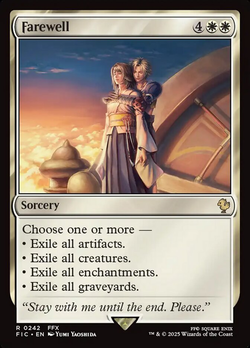
For the second time, Magic managed to adapt Farewell in the most touching way possible for a certain audience coming from Universes Beyond.
The ending of Final Fantasy X is, by far, one of the most striking in the series and expresses a bitter feeling when we finally follow the outcome of Tidus and Yuna's long journey, and realize how breaking the cycle would inevitably lead to some sacrifice, and that Tidus' farewell was a necessary step for Spira to start over.
The fact that the card exiles all permanents — Final Fantasy doesn't have Planeswalkers — also works to tell the narrative around the feeling of loss that the farewell leaves in Tidus and Yuna, while also symbolizing the end of the game.
4 - Cloud's Limit Break
Having Limit Breaks as Tiered spells was a common element in the main set, and only Cloud received his version in Commander decks.
Just like Limits in FFVII, the spell is divided into three categories, getting stronger the higher the additional cost. While the idea of destroying only tapped creatures removes its viability outside of Commander, the representations of Cross Slash destroying a creature, Blade Beam, which destroys creatures of different players, and Omnislash dealing with all tapped creatures, are extremely accurate to the power of each ability in the game.
3 - Sin, Unending Cataclysm
The first ability of Sin, Unending Cataclysm represents the destruction that its presence causes in the towns and cities of Spira by removing the counters from all permanents to increase its power. The second ability represents the Final Summoning of Yevon's teachings: Sin, in fact, ceases to exist for a time with the ritual, but the Summoner must sacrifice one of their guardians for the act, which in turn, will become the next Sin, repeating the cycle.
Although simple to explain, this was clearly one of the most accurate designs of a new card in Commander decks, and the cycle of Spira can be reproduced on the boards if its controller has the means to put Sin on top of the deck, or to fetch it each turn.
2 - Sephiroth, Fallen Hero
Sephiroth being in Boros is quite unusual, since this combination is commonly associated with justice, but there are some circumstances where it is associated with fury and this card, visually, represents the Nibelheim flashback.
His abilities, however, reflect the concept of how Jenova's cells work with the villain: Professor Hojo did several experiments with them on living beings, discovering a dozen possibilities, including the Reunion — the thesis that, if Jenova's body dismembers, its pieces will eventually join together in a single point.
Sephiroth manages to impose this theory and have the bodies that have Jenova's cells become his avatars as they travel the world searching for the original vessel.
This concept also brings another narrative element from the FFVII compilation: in Advent Children, Sephiroth returns by uniting with Jenova through Kadaj, one of these vessels. His second ability, therefore, may be associated with the events of the film, rather than the original game.
1 - Hildibrand Manderville
You probably don't know Hildibrand Manderville if you haven't played or done the side quests of Final Fantasy XIV, but I guarantee: no other card in Commander decks transitions so well between its role in the game and as a Magic card.
Hildibrand is a detective who stars in a series of quests known as Hildibrand’s Adventures, where most of them function as a kind of comic relief. His card represents the first quest in his line: after surviving catastrophic events, the character woke up surrounded by zombies and, believing he had become one of them, began to live with his “peers”, teaching them how to be true Gentlemen beyond death.
Eventually, the hero must face these zombies as part of the quest and, yes, they flex their muscles while fighting. Upon finally finding Hildibrand, the detective then realizes that he has not become a zombie and is more alive than ever — in fact, Hildi is practically immortal considering the amount of absurd situations that happen to him, and that is why he can be played from the graveyard.
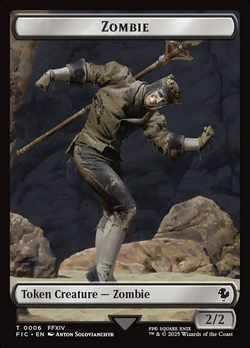
And to further enhance this card’s representation, the FFXIV Commander deck comes with a 2/2 Zombie token that flexes its muscles, wears a suit, and… whose teeth gleam in the sun.
Wrapping Up
That’s all for today!
If you have any questions, feel free to leave a comment!
Thanks for reading!








 Sign in and join the conversation
— Comments 0
, Reactions 1
Be the first to comment