
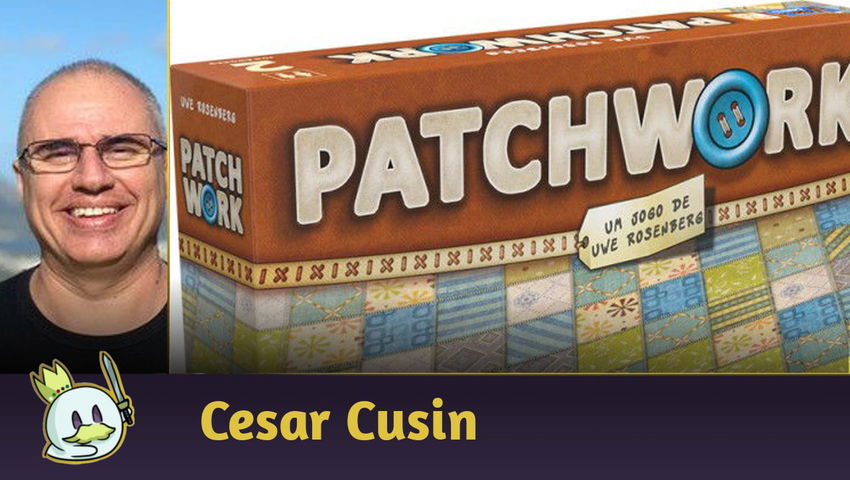











About Patchworks
Patchwork is a form of needlework that involves sewing together pieces of fabric into a larger design. It differs from other sewings because it's often highly unique, as there are endless possibilities within the same available fabrics.

In the past, it was a way to make use of left over pieces of cloth to create clothing and quilts. Today, patchwork is a form of art, in which the designers use precious fabrics to create beauti ful texti les. The use of uneven pieces of fabric in parti cular can result in real masterpieces and is therefore being practi ced by a large number of texti le arti sts.
Let's meet the Patchwork board game!
Patchwork - Game Info
Patchwork is a 2-Player game, age 8+, by designer Uwe Rosenberg. Art by Klemens Franz.

Patchwork was released in 2014 by Lookout Games and, in Brazil, it first arrived in 2016 by Ludofy (now Grok Games), and in 2022 by Galápagos Jogos (now Asmodee). Among the mechanics, the following stand out: piece placement, end-game bonuses, time track, victory points as resources and rondel.

Patchwork has been a hit since it was released. It won the following awards:
- 2014 Golden Geek for Best Abstract Game;
- 2015 it won the Spiel der Spiele Special Prize;
- 2017 the Årets Spel for Best Family Game.
Playing the Game
The idea is to put together a beautilful patchwork quilt. To do this, we use our individual board as our quilt and several patches at our disposal, which can be purchased at different prices. We're also limited both in time and in available space, which makes things even more challenging. Each patch we choose can take more or less time. We must manage all of this and, when time runs out, have the best and most complete patchwork quilt.
This is the scenario for Patchwork!
In Patchwork, two players compete to build the most aesthetic (and high-scoring) patchwork quilt on a 9x9 individual board.
The setup is quite simple. Each player takes their individual board, which will be their base for "sewing" the patches, and receives 5 buttons, which in the game have a dual role: they're used as both money and victory points.
Place the main board in the center of the table. It represents the time track and has 5 special locations, each with a 1x1 patch, which helps fill roles on your individul board. Place both player's markers at the beginning of the main board.
Now, randomly distribute all the patches in a circle around the main board and place the neutral marker between patch 1-2 (1 time and 2 cost) and the next patch. Leave the special 7x7 (bonus) piece next to the board. And that's it!
This image shows a complete setup:

Each turn is simple, yet highly strategic. You just choose one of two possible actions:
- Action 1: Take and Place a Patch;
- Actino 2: Advance and Receive Buttons.
In Action 1, you'll Take and Place a Patch, which consists of 5 steps:
- Step 1) Choose a Patch: you can choose one of the three next in clockwise order to the neutral token.

- Step 2) Move the Neutral Token: place the Neutral Token next to the chosen Patch.

- Step 3) Pay for the Patch: return to the general supply an amount of buttons indicated on the label.

- Step 4) Place the Patch on your Quilt Board: you can rotate the Patch any way you like before placing it on your quilt board, and you cannot overlap another Patch.

- Step 5) Move your Time Token: Move your ti me token on the main board by a number of spaces as depicted on the label.

If at the end of Step 5 you finish on the same space as an opponent's time token, put yours on top of theirs.
These are the five steps within Action 1: Take and Place a Patch.
If you choose Action 2, Advance and receive buttons, you must advance your time token on the main board so that it occupies the space directly in front of your opponent's token. This gives you 1 button for each space you advanced.

Choosing this action usually means one of the following:
- you want buttons, which represent money and points in the game;
- the available Pach options for sale don't suit your strategy;
- you don't have enough buttons to pay for the Patch;
- or simply as a strategic choice.
During your turn, there are special spaces on the main board, and regardless of the action (1 or 2), passing through these spaces can trigger important events, such as:
- Special Patches;
- Button Income.
In the case of the Special Patch, when you pass through the corresponding space, you take the special 1x1 patch and immediately place it on your board. These special patches are the only way to "patch" unique empty spaces in your quilt. Only the first player to pass through this space wins the special patch. It's a real race against time!

An important detail: if, at the end of any chosen Action, your Time Token is behind or on top of the other player's Time Token, you will continue playing; otherwise, it is now the opponent who takes the turn.

This is an important change from usual boardgame rules. Normally, at the end of a turn, the next player continues to play. In Patchwork, things are a little different, which brings a whole new strategy level to the game, since you can try to plan one or more extra turns.
When you pass on the special space marked Button Income, you receive a number of buttons equal to the sum of all buttons on your patchwork (individual board).

There's also another surprise: whoever fills an entirely 7x7 square will receive the Special 7x7 Tile, which is worth 7 victory points.

This is a turn in Patchwork!
Ending the Game
The game ends when both time tokens reach the last space on the main board. If a time token would move beyond the last space, it simply stops there. If you use Action 2, i.e. Move and receive buttons, you will only receive buttons for the actual number of spaces moved.
Scoring goes like this:
- Count the number of buttons you have;
- Add the value of the special tile, if you have one;
- Subtract 2 points from your score for each empty space on your quilt board.
The player with the highest score is the winner. In the event of a tie, the player who reached the final space on the main board first wins.
Strategy Tips
Patchwork is about reading the board and your opponent's board. It's about making the best choice between the available patches while managing your buttons. The game is simple and fast, yet challenging.
The simple act of choosing a patch is already highly strategic. After all, there are three available. More than choosing the best one for your quilt, don't forget to consider where the neutral marker will end up—that is, which other three options you'll leave available to your opponent. It's important to look at the whole picture here.
Also consider the button cost of the patch and the time you'll spend sewing it. Sometimes, there will be patches that cost no buttons, but end up taking a lot of time. Remember to check the cost and time for each patch.
Placing the chosen patch on your quilt board is no less challenging. Position it so that it allows you to place other adjacent patches without "blocking" important spaces. Think carefully before placing the patch. Relying on special 1x1 patches to fill spaces can be risky, avoid it if you can.
You should also consider the possibility of an extra turn when choosing a Patch. If you don't exceed your opponent's token or land on top of them, you'll gain another turn. This can be the deciding factor between victory and defeat if you're aiming for another patch. Don't ignore this opportunity.
Of course, sometimes, strategically or for lack of options, opting to simply advance and receive buttons may be your only option. This isn't entirely a bad thing, as buttons represent money and points in the game. Use this to your advantage as best you can.
Don't lose focus on the "race" for the special 1x1 patches. They can save your patchwork by filling empty spaces. Only the first player to pass through the special space gets the patch. There are only 5 in the game, so it's worth it!
If you need buttons, passing through the income spaces is the solution. This can be done quickly if your opponent is one space behind the income space. Simply buy a patch that takes enough time to overtake your opponent, or choose to advance and receive buttons. You stop at the next space and still receive your income. It's a great way to accumulate buttons.
And of course, without your opponent noticing (or allowing them, if they can't avoid it), quickly fill a 7x7 square in your quilt. This guarantees you the special 7-stitch piece at the end of the game. It's a game-changer!
With these tips, manage your buttons and patches, develop your best strategy, and win at Patchwork.
Unboxing, Rules, and Gameplay Videos
Unboxing
Rules
Gameplay
Pedagogical Tips
If you're looking for a quick, easy-to-explain, yet highly challenging and strategic game, Patchwork is the game for you! It also offers several important stimuli for children.
The game takes the concept of management to its maximum level. You must manage:
- buttons, which are both money and victory points;
- patchwork costs;
- time;
- distance in spaces to your opponent;
- and so on.
It's a true management lesson, and best of all, it's fun!
The strategy is evident from the choice of patches to the pros and cons of each decision: where to position them, where the neutral token will be, and which patches will be available to the opponent. This develops the concept of decision-making, teaching children that every choice involves either a sacrifice or a valuable lesson.
Calculating income stimulates children's logical-mathematical reasoning. These are small additions and multiplications that exercise the mind.
Finally, positioning the patches requires a sense of spatial orientation, something very important to develop. Kudos to the game for addressing this in such a lighthearted way!
Pedagogically, Patchwork is a lesson in resource management. It encourages strategy, decision-making, logical-mathematical reasoning, and spatial orientation, while also being fun!
I recommend Patchwork for your collection!








 Sign in and join the conversation
— Comments 0
, Reactions 1
Be the first to comment