










This year is the fifth in which I've worked directly with content about card games, and in 2026, it will be 20 years that I've been following the niche, 18 of which have been spent playing Magic: The Gathering, my main focus of coverage on this site.
In one of my first articles, I mentioned how Magic was changing. At the time, the reason had to do with the changes and challenges that the pandemic brought to the game, with a greater focus on Magic Arena, the waves of Power Creep with cards like Omnath, Locus of Creation and their excessive effectiveness when compared to cards from the past decade, such as Siege Rhino.
There were also other topics discussed: bans as a regulatory tool (now we ask for more bans), the notorious perception that Magic was becoming increasingly a product to be sold (now we have seven sets in a year and a dozen Secret Lairs with each release), and that, despite the general feeling of the community about some decisions, the final word was Hasbro's.
Five years have passed, and of all the periods I've spent following this game and actively working with it, looking back this December, 2025 was the most exhausting to cover Magic.
At sixteen, when I had my first year with Magic, I spent a lot of time enjoying the game and studying it: decks that made history, theories about game concepts, famous players, and many other things that were available in the far reaches of the internet and in old and new forums — it was a passion, a hyperfocus that gave me the privilege of meeting people, experiencing various formats, and finally, creating content about Magic and having my voice heard or read.
Now Magic feels like just another game. One that releases products more frequently than it should, announces things earlier than it should, and doesn't allow you to enjoy the latest releases because it needs to instantly redirect the consumer hype to something else, giving little importance to the beauty of the game itself. There's no more enjoyment, especially when creating content—the focus will always be on the latest release, regardless of whether it just came out or will only be released in June 2026.
To be clearer, two events occurred last week that highlight the tiresome aspects of the card game this year. The first was the World Championship 31, and the controversies surrounding the champion Seth Manfield, which, despite being ugly to see such sloppy misplays at Worlds and adding very little to the "professional" tone expected of an event of this magnitude, weren't the biggest disappointment.
In fact, there's a point I'd like to make regarding this matter: how can we demand more professionalism from the most important Magic tournament of the year when Magic doesn't treat itself, the players, or the World Championship itself with professionalism? When we don't demand anything from Magic and settle for the bare minimum, who are we to demand that the game take itself seriously?
Just look at the official coverage of the event: flawed, visually unappealing, lacking anything that would make this event, the pinnacle of competitive Magic, a spectacle worthy of its name—instead, it focused exclusively on offering more of the same, repeating everything it already does for the Pro Tour, without giving it any substance that would make it a World Championship worth watching.
The second annoyance stemmed from how Wizards gave up airtime just days after the World Championship to the excessively anticipated previews of Marvel Super Heroes, an expansion scheduled for release in June 2026, and how the company's entire social media focus neglected the event during its coverage but spared no effort in ensuring that Marvel announcements were something everyone should eagerly anticipate.
The sum of these two events encapsulates what has made me lose my passion for the TCG. I always cared about Magic while playing it, and it was exciting to follow the Grand Prix or even the SCG Opens to see how the formats developed, which decks were standing out, and to enjoy a good tournament while doing other activities—it was also what created my desire to play in stores and build and study decks, not always out of a desire to be a competitor dreaming of reaching the Pro Tour one day, but for the sheer beauty of "well-played Magic".
Now, it appears that this same "well-played Magic" is being left behind. One argument in the Manfield case is that this type of action and other misplays shouldn't ideally happen at the peak of competitive Magic because it leaves the impression that the game is sloppy, but the reason this feeling exists is due to the low importance that Wizards of the Coast gave to the biggest event of the season—and the players, in part, also paid little attention to the event.
In an ideal world, the World Championship 31 should be the culmination of everything Magic: The Gathering achieved during the year in which it once again broke sales records with the release of Final Fantasy, and the pinnacle of the game's competitive scale — what should have happened is a grand spectacle of the card game with coverage worthy of the tournament's name and the competitors who worked hard throughout the year to reach this moment.
What we got, however, was an event with coverage incapable of doing anything beyond what Magic has already done for an entire decade. For practical purposes, the coverage of this year's World Championship was the same as any Pro Tour, with nothing to distinguish it in comparison besides a Black Lotus trophy that, apparently, wasn't designed to be lifted at the crowning of the champion.

By more of the same, I mean “an unappealing broadcast”. The official streaming of the Pro Tour (and the World Championship) isn't visually attractive to watch. The camera angles are unflattering, the lighting and set design lack charm, and most importantly, it doesn't make Magic seem like a fun game to follow—no matter how much the event's coverage team tries to make a match sound exciting, it's still just players with grumpy faces sitting at a table while cards scatter across the corners, and the team struggles to keep track of all the information for the viewer.
The interface itself doesn't help. Since it lacks sufficient visual information and focuses too much on elements like "cards in hand," the broadcast makes Magic seem even less inviting as entertainment for those watching from the outside, as it lacks "sparkle," enough visual attention to keep the viewer engaged even if they don't fully understand what's happening.
For streaming purposes, it would be preferable to give more prominence to the events at the table instead of forcing the audience to mentally test their attempts to "predict" the competitors' plays during the tournament. Yes, it works for the Magic audience—although it's somewhat boring because we're talking about the best players in the world, and we mere mortals ideally won't be making the most assertive plays—but it doesn't work for anyone else.
Besides the problems during the streaming, the coverage also left much to be desired in other aspects. On social media, there was little to no reaction from Magic: The Gathering's pages about the tournament—at the time of writing this article, the game's official Instagram hasn't yet announced Seth Manfield as World Champion, perhaps as part of the crisis management surrounding the Top 8 controversies—and there was no pre-event action that generated hype and engagement among the target audience.
At most, a single article was published on the official website commenting on the "players to watch." It's not enough; on the contrary, the "pre-game" of a World Championship can be much more than just talking about the players, such as having an official livestream the day before or hours before the event talking about Metagame, decks (with aggregated lists or just key cards to keep decklists discreet until the Standard rounds), standout players, and even interviews to discuss expectations for the tournament — you just have to want to treat the Magic World Championship as, well, the World Championship of the best card game ever.
Consequently, many didn't care that the event was happening. On the first day, I went to a local store that holds Standard tournaments every Friday night. On the television screen, a Counter-Strike tournament was playing, and when I commented that the Standard rounds were happening at that exact moment, this same audience, Standard players, didn't care enough to want to exchange the streaming of another game for the most important tournament of the TCG they were playing.
This example, while small and perhaps anecdotal, demonstrates how low the value of competitive Magic is today for the audience. Talking to other people from different regions, I realized that many didn't even know the World Championship was happening, and discussions in their stores were much more focused on the potential Marvel Super Heroes spoilers that would probably happen the following Tuesday than on the biggest tournament of the year.
Perhaps competitive Magic no longer has value. The only ones who care about it are those who still try to live the dream of playing in a Pro Tour, and for the rest, it's just another layer of the smaller game that, due to a lack of investment in decent coverage and in building media outlets that properly promote its major tournaments, Wizards of the Coast itself seems to neglect and not give due importance to.
I was one of the people who grew up in a world where competitive Magic was the main gateway, where watching the Pro Tour not only showed the highlights of the new sets in the featured format but also served as inspiration: you wanted to be there, in front of the cameras, with people cheering you on as you competed with the giants of the game for the glory of reaching Day 2 and, who knows, the Top 8.
“Play the game, see the world” was the keyword that inspired many to try their best to master their decks and knowledge of the Metagame and the game, and this was a lasting result of a strategy conceived back in the 90s that aimed to try to make the perspective of the professional Magic player similar to that of a professional athlete — people would look at them on the television screen or their computers and think, “I want to be like this guy!”Now, it seems this world is withering, and the inspiration to compete in Magic: The Gathering is being minimized both by the public, who no longer seem to give due importance to major events beyond fueling angry social media discussions on any subject, and by Wizards of the Coast itself, which doesn't dedicate enough resources to making the World Championship the spectacle and celebration it should be—a shame, considering the game continues to break sales records year after year, and the top players deserve due recognition not only in decent prizes but also in attending and being recognized at the biggest event of the best card game.
The curious thing is that Magic invested heavily in spectacle in the recent past but didn't get the expected return due to circumstances it couldn't foresee. When the game was attempting—and failing—to break into the eSports universe, the coverage of major events at that time featured much more vivid camera work, lighting, and dynamics than what we have today, even if we have criticisms regarding the execution of the project through Magic Arena when, during the pandemic, it proved incapable of providing even a minimum level of quality, partly due to the absence of a spectator mode, which remains nonexistent to this day.

We went from the scene above at the 2019 World Championship to whatever it was the 2025 World Championship celebration, where half a dozen familiar faces clap while the champion faces the camera without showing any reaction, and the trophy doesn't even look like it was made to be held, with a setting that is the same used for all Pro Tours and lighting that makes it seem like the final round was played in an event hall about to close.

Magic deserves more than this. With its growth in recent years and attempts to break into the mainstream scene with partnerships with Universes Beyond, it was to be expected that some investment would be applied to making the World Championship seem like a major event for the outside audience, even to make it more visually appealing to these viewers.
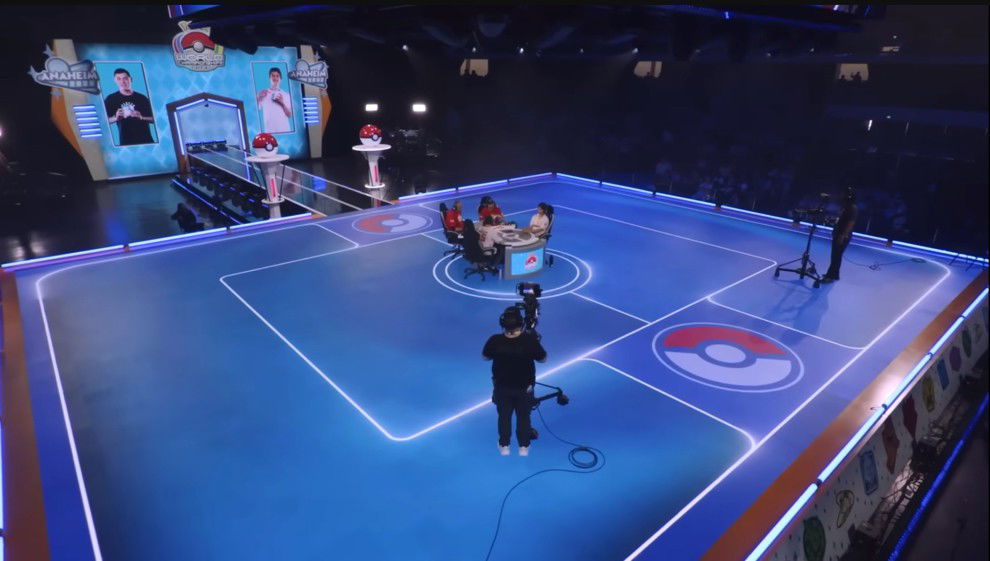

If we compare it to the World Championship of most other card games, the difference is noticeable, and Wizards/Hasbro should aim to provide at least a third of what Pokémon, Yu-Gi-Oh!, and other big games offer, instead of getting used to doing more of the same and lowering their standards.
But it seems the priority lies elsewhere.

After all, why bother with post-World Championship coverage, an interview with the champion about the tournament, when you can just jump straight to more previews before the year ends? And for a set whose release is only scheduled for June 2026?
The complaint about spoilers being revealed too early might seem redundant, but it serves as a reminder of where Magic: The Gathering's priorities lie today—that of a product to be sold above any other intrinsic value the game possesses, including the competitive scene and building the perception of the game as something worth dedicating yourself to to be among the big names in it.
I ostentatiously repeat that Magic is a product to be sold, because it is. Every entertainment product is made to generate revenue, and every investment in a new card game expansion is made to generate profit, but at this point, it seems to me that this is the only thing that matters for Wizards of the Coast/Hasbro in Magic.
In recent years, we have seen considerable growth in the card game niche, beginning during the pandemic and mainly caused by the artificial feeling of increased purchasing power caused by the financial aid given during the lockdown. It was during this time that the boom in Pokémon TCG collecting occurred, while movements around the "collectible investment" trend in Magic had already begun years before, with the Reserved List experiencing spikes just for the non-reprint policy years earlier.
Since then, the scene has exploded, and now we have different types of card games for all tastes, including some with considerable controversy, such as Riftbound, whose demand was considerably higher than the supply and brought a dozen problems involving scarcity, scalping, among others.
Today, the perception—and a rigid culture within the card game audience since the genre's inception, just look at the reason for the Reserved List's existence—is that the market for this niche is treating a hobby as an investment, a kind of collectible cardboard NFT in the expectation that, in five or ten years, these will be able to earn you a car or even a house based on a collectible value, and every card game has jumped on this bandwagon, offering all kinds of "premium variants" of their cards for the public to buy boxes in bulk and keep the machine running.
Magic: The Gathering is no exception, and it has adapted exemplarily from a marketing perspective to the demands of a "new audience": you announce Marvel Super Heroes six months before launch to generate engagement, hype but also to announce, "Remember that next year, this is coming for you to invest in."
And if this is the direction the market has taken, then the audience's priorities also change, and competitive play ceases to matter, as it is no longer the motivating aspect of the product—collectibles and investment take that place—and if this no longer functions as a tool to solidify consumption, then the reasons to invest in them, from a company's perspective, more concerned with profit than with the culture of its own game, only tend to diminish.
Ten years ago, when I watched the broadcast of the 2015 Magic World Championship, there was a slight feeling of pride in seeing how the game I followed was gradually becoming more professional and gaining the refinements of a "competitive sport." Now, not only does it seem that the quality of Magic's coverage has stagnated and offers nothing new since the Pro League's failure, but it also gives the impression that, regardless of breaking sales records one after another, Wizards of the Coast doesn't consider it necessary to invest in the top of its competitive scale or transform its tournaments into grand spectacles.
This may seem like a loss only for a small segment of the game's consumer audience, but in reality, the entire Magic audience and the game's brand itself lose when the company responsible for it doesn't bother to value its own World Championship.
And this year, at the end of the event, that's undoubtedly what World Championship 31 conveys: that it means nothing. That Magic, as a competitive game, doesn't matter right now.







 Inicia sesión y únete a la conversación
— Comentarios 0
, Reacciones 1
Se el primero en comentar