










Friendly Neighborhood!
Hello, everyone!
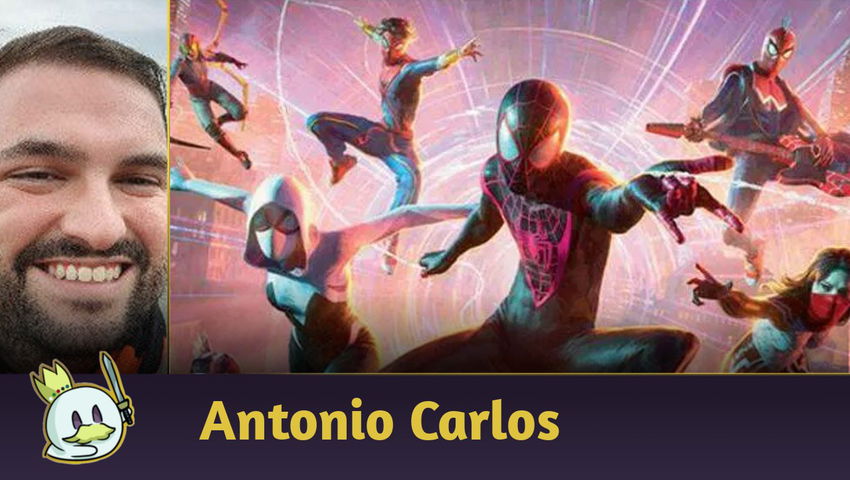
Another new Magic: the Gathering Set approaches! This time, the Universes Beyond will feature the Marvel Universe, focusing on one of the most famous and beloved heroes: Spider-Man!
Like other Universes Beyond sets, it will be entirely on-theme with Spider-Man's stories across the multiverse: iconic characters, canon events, and more—in short, a whole set uniting Magic with the Marvel's* world.
Of course, new set also means new mechanics! We'll talk about them and highlight some cards, and try to anticipate some questions that you may have.
Get ready, we're about to enter the Spider-Verse!
Marvel's Spider-Man - Mechanics
For this set, we'll have three new mechanics—although one of them, so far, shows up in one card—, and two existing mechanics. Of course, some of the new mechanics also reference older ones, but we'll make sure to clear everything up for you.
Let's start with the existing ones, and then the new ones.
Modified

Modified is an ability we saw back in Kamigawa: Neon Dynasty, and it returns in Spider-Man.
Basically, modified is a status that a permanent can have, when it's affected by one of three things: equipment, counters, or auras you control.
In the example card above, Silver Sable, when it attacks, it will grant lifelink to a target modified creature—it could even be Silver Sable itself, since it doesn't say another creature.
Important: Only Auras you control will make your creature modified. In other words, that Pacifism your opponent used on your creature won't give it the status. However, counters don't have this same distinction - if an opponent, for example, uses an effect that puts a -1/-1 counter on your Silver Sable, it will be considered a modified creature!
Connive
This mechanic was part of the Obscura in New Capenna, and now returns in Spider-Man. Connive is a keyword ability that indicates the following actions, in this order: draw a card, discard a card, and if you discarded a nonland card, the permanent (usually a creature) will get a +1/+1 counter.
Important: It's all just one ability, including the +1/+1 counter! In other words, let's say you have something to deal 1 damage to Doc Ock's Henchmen—a Lava Dart, for example. If you let the Connive ability resolve, and a nonland is discarded, Doc Ock's Henchmen will immediately get the +1/+1 counter. There is no priority between the discard and the +1/+1 counter being placed for you to respond. In this case, you can cast Lava Dart before Connive resolves, while the creature is still a 2/1.
Harness
Harness is one of the new mechanics from the set—and it shows up, so far, on only one card: the powerful The Soul Stone.
Harness is a status that a permanent can have—for The Soul Stone, that's when you pay the cost of 

 , exile a creature you control. This causes the ∞ ability to become active.
Harness is connected to the object, so if an effect, for example, blinks The Soul Stone (it leaves and then returns to the battlefield), for all intents and purposes the game considers it a new object, and Harness is no longer active. You must pay the cost again to have the Harness effect.
Mayhem
Mayhem is a new ability… very reminiscent of an old one: Madness. The old mechanic is famous for cards like Basking Rootwalla and Fiery Temper, but also somewhat unintuitive, as it involves zone changes and a kind of strange timing to cast the spells - confusing even for veterans.
So, the new ability, Mayhem, is like a modernization of Madness. Basically, if a card with Mayhem was discarded this turn—that is, it went from your hand to your graveyard—you can cast it from the graveyard, by paying the Mayhem cost!
Note that Mayhem respects the card's timing—for example, Electro's Bolt is a sorcery, so if you discard it on your opponent's turn, or during your combat phase, you won't be able to cast it—only during your main phase, and with the stack empty.
Of course, there are instant cards with Mayhem, or creatures with Flash, that will be possible to cast at any time. Pay attention to your cards' timing restrictions, and surprise your opponents!
Web-Slinging
Another new ability! Like every hero that arrives at the right time, several cards in the set have the new keyword: Web-Slinging.
Web-Slinging is an alternative cost, similar to Evoke, Warp, etc. What sets Web-Slinging apart is its additional cost: in addition to paying mana, the ability requires returning a tapped creature you control to its owner's hand.
Important: Since it is a cost, it is not possible to respond to something cast with Web-Slinging and remove the tapped creature. By the time the card is put on the stack with Web-Slinging, the creature will have already been returned to hand.
Like Mayhem, Web-Slinging also respects the card's timing, so creatures without Flash can only be cast in the main phase, with the stack empty. And just like Mayhem, the mana cost to be paid can be affected normally by reducers, amplifiers, etc.
Bonus: Modal Double-Face Cards
While it's not new, it's worth mentioning that some cards in this set are Modal Double-Faced Cards, or MDFCs—meaning you can choose which side you want to cast.
These cards symbolize the transformation of some Spider-Verse characters, as seen in the example above. Peter Parker can be cast either his front side, or his other side, Amazing Spider-Man.
Note that the Peter Parker side has the ability to transform into the Amazing Spider-Man side, but it can't transform back! There's no going back on the hero's path, so to speak.
Important: Cards or effects that allow you to cast one side may also allow you to cast the other—in this case, it depends on what restrictions the card or effect has.
For example, if you cast a Bring to Light with at least two colors of mana paid, you can choose Peter Parker from your deck—you always consider the DFC's front side. However, when casting it, you can choose the other side, Amazing Spider-Man, since Bring to Light doesn't impose any other restrictions.
The same doesn't happen with the Cascade ability, for example. A Shardless Agent that finds Peter Parker on top of the deck will only allow you to cast the Peter side, since the Spider-Man side has a cost greater than two, and therefore doesn't meet the Cascade restrictions.
Conclusion - With Great Power Come Great Responsibility
And so we conclude our look at the mechanics of Marvel's Spider-Man!
I hope everyone has a lot of fun with the new set, have a great pre-release event, and thoroughly enjoys this new Universes Beyond!
If you have any questions, suggestions, or feedback, feel free to leave a comment down below.
Cheers, and see you next time!






 Inicia sesión y únete a la conversación
— Comentarios 0
, Reacciones 1
Se el primero en comentar