









Magic: The Gathering has a long, long history. It's been on the run for 32 years, and over each of those, the game has gradually evolved into what it is today, with new concepts learned by players, new deckbuilding methods, and even new ways to compete and enjoy MTG as a social tool.
In this series of articles, we delve into the history of Magic: The Gathering, one deck at a time, showcasing archetypes and strategies that played an important role in shaping the TCG and celebrating the card game's long success in these changing times.
Today, we'll cover a lesser-known archetype in the game's mainstream: the list ranby Betrand Lestree, runner-up at the first Magic World Championship, which arguably represents the first competitive Aggro deck in the card game's history.
Lestree Zoo - The First Aggro

Bertrand Lestree was a French player who reached the finals of the first Magic: The Gathering World Championship, where he faced Zak Dolan in the TCG's first classic finals match: Aggro vs. Control.
Dolan ran a Stasis deck with Serra Angel and several one-ofs that gave him a huge advantage in each game when combined with Braingeyser, Demonic Tutor, Regrowth, and Recall, while Lestree sought to take advantage of cheap damage spells and threats similar to an archetype that, years later, would also emerge around Kird Ape and Lightning Bolt — Zoo.
Lestree complemented the creature shell with two other threats that are, in part, Meta Calls. The first, Argothian Pixies, had a decent body for its cost at the time, but also had the advantage of preventing damage from any artifact creature and being unblockable by them—both elements that directly responded to Juggernaut, a powerhouse of the era as a four-mana 5/3 that fit into any deck.
Whirling Dervish served a dual function. Besides protecting itself from cards like Terror and blocking Juzam Djinn eternally, it also grew with every combat in which there were no blockers to hold it, increasing the pressure that interaction spells provided by keeping the board clear.
Complementing the creatures, Lestree had a total of 14 damage spells. In addition to the combination of Lightning Bolt and Chain Lightning, the Frenchman opted for a full Fireball set, which benefited from the ramp of Moxes, Black Lotus, and Birds of Paradise, as well as a two-card combo with Channel, which led to the spell's restriction at the time.
Lestree also opted for Psionic Blast, a blue damage spell that dealt with Serra Angel and Serendib Efreet, which he used in the sideboard and may have been due to its ability to avoid Lightning Bolt and have an efficient clock.
Just like in Vintage today, there was little reason not to run the Power 9 in a deck back then, even in Aggro. After all, free mana was always good, and the extra draws and turns from Ancestral Recall and Time Walk could be the difference between victory and defeat.
The combination of Demonic Tutor and Regrowth helped reuse powerful cards and search for other restricted spells of the time, such as Mind Twist and Channel, in addition to providing a small toolbox for better interaction with the board with Icy Manipulator and Control Magic.
The combination of duals with City of Brass ensured easy access to colors at the right time, especially at a time when Wasteland didn't yet exist and Strip Mine was a restricted card. And even back then, the potential that Manlands had to pressure Aggro decks was already evident, with Lestree including a full set of Mishra's Factory.
Lestree's sideboard has some peculiar choices, and there are no records explaining them. There are several color hosers that work against Islands, Plains, or black spells, along with City in a Bottle to punish Arabian Nights cards, even though the deck's main beater belongs to that expansion.
The most interesting choice, however, is Serendib Efreet. With today's philosophy and the card pool of that era, it's possible that Efreet would have been a maindeck card as a 3/4 with Flying for 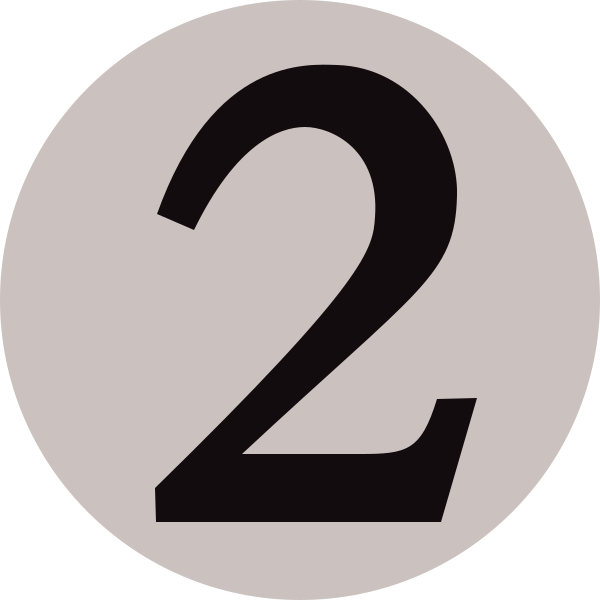
 was well above average, and the goal of this deck is to be faster at finishing games.
But this concept of "taking damage in exchange for more speed" only became popular years later, and Lestree chose to include the creature in the sideboard, possibly as a way to have a threat that could survive against traditional damage spells while "compensating" for the life loss if it took a Swords to Plowshares.
The Historical Legacy of Lestree Zoo
While it's not as remembered as decks like Sligh in the making of what would become Magic's Aggro decks in the future, Lestree Zoo is essentially the first record of an aggressive archetype with the mold we know today: cheap, aggressive drops that grow with some condition, combined with damage spells that also serve to remove blockers from the board.
Obviously, there are some suboptimal choices, as there were in Zak Dolan's list, but if we compare the two archetypes, Bertand's list was far ahead of its time and the consensus on how a Magic: The Gathering deck should function.
Years later, Zoo would become an established archetype in Ravnica Standard, Extended, Legacy, and even Modern. In Standard at the time, the archetype starred in one of the most iconic moments of a competitive Magic tournament, known as the "Topdeck of the Century".
Today, Zoo is a five-color Modern archetype that no longer needs Kird Ape when it has cards like Territorial Kavu, Wild Nacatl, and Scion of Draco along with Leyline of the Guildpact and Tribal Flames.
Bertrand Lestree may not have reaped the laurels or glory of perhaps taking the first historic step toward the existence of Magic: The Gathering's Aggro archetypes, but his contribution to the game is undeniable and should be remembered.






 Sign in and join the conversation
— Comments 0
, Reactions 1
Be the first to comment