










The Birth of the Deck vs. Anti-Deck Standard
An excellent way to understand how Magic formats develop and how they can go wrong is inevitably to look at the current state of Standard over the past few months.
At the end of last season, the format underwent drastic changes in what Wizards of the Coast calls "yearly maintenance," a Banned and Restricted update aimed at cleaning up everything that's wrong with the format and paving the way for rotation. At that time, four cards were banned, and all the problems seemed resolved, except for the obvious elephant in the room that would not be banned under any circumstances at that moment: Vivi Ornitier.

While everyone worried about Izzet Prowess's potential to continue dominating the format, Izzet Cauldron emerged and, little by little, became the best strategy. For this deck, circumstances created the perfect storm: the archetypes playing under it suffered major losses, one of the most effective Tempo plays against Agatha's Soul Cauldron, This Town Ain't Big Enough had also been banned, and the rotation took away cards like Tranquil Frillback and other predators that would keep it in check.
As a bonus, the archetype also received both the best possible support to break its key card with Vivi Ornitier and good enough support to stand on its own without the combo with Marauding Mako, Looting effects, and Proft's Eidetic Memory.
On August 9th, the Izzet Cauldron solidified its position as the best deck in the format by representing 54% of the Arena Championship Metagame. Although the low player count raised some questions about sampling, it was clear that more than half of the competitors at Magic Arena's most important event opted for the same archetype—it was clear: Cauldron needed to be beaten, and how they tried.
The answer came at Spotlight Series Orlando: Izzet Cauldron had one of the best conversions from the first to the second day of the event and placed six copies in the Top 8, setting off alarm bells in the community even louder. But at the same event, what would be the answer to dealing with it emerged, and a bitter one for a format that had once been dominated by the dynamic between an Izzet deck and the archetype that could play faster than it: Mono Red Aggro.
Despite being the event's winner, the way Mono Red was being constructed clearly signaled that it was an "Anti-Deck." It wasn't just about playing faster but also punishing any action the Izzet Cauldron commonly takes: drawing cards, playing too many spells, or overgrowing its creatures without adequate protection for an Act of Treason effect.
Since then, Mono Red Aggro has become the most popular archetype in Standard. In the last 15 days, the archetype has had a 27% tournament presence compared to Izzet Cauldron's 24%, and the reasons are diverse: when there's a best deck, players tend to migrate to the one that beats it, and Mono Red is currently Cauldron's predator. As a bonus, it's a much more practical and faster archetype to pilot, and a strategy many players were already accustomed to because it was already the most popular strategy before Monstrous Rage and Heartfire Hero were banned.
Together, Izzet Cauldron and Mono Red Aggro now make up over 50% of the competitive Standard metagame, presenting a clear "deck vs. anti-deck" trend in tournaments, with the only other archetype showing significant numbers being Dimir Midrange, currently at 14%.
Dimir Midrange has a few reasons for achieving this position: besides being as popular as Mono Red in terms of gameplay and high representation in the pre-rotation and post-banlist format, the archetype is extremely flexible in the maindeck and sideboard, giving players room to try to solve the format outside the current axis. For example, most lists today rely on a full set of Azure Beastbinder to disrupt Cauldron.
This forms the Standard triad. This is where there's a broken strategy (Izzet Cauldron), a natural predator of that strategy that wins based on speed (Mono Red Aggro), and the popular and flexible archetype that achieves less impressive results but is always more represented compared to the rest, which are always below 5%.
The Other Deck vs. Anti-Deck Environments
It feels familiar because it is familiar.
In June 2021, Magic released Modern Horizons II, the game's best-selling set before Lord of the Rings, and one of the biggest power creep jumps in the game's history came from this expansion in the eternal formats. While cards like Ragavan, Nimble Pilferer received fame and infamy for their power level, Pauper was perhaps the format most harmed by MH2.
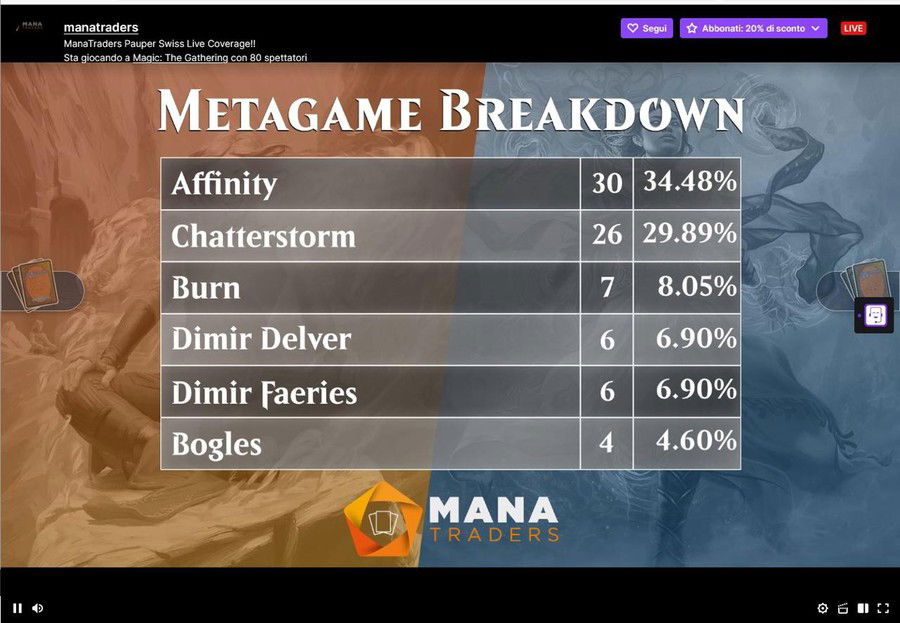
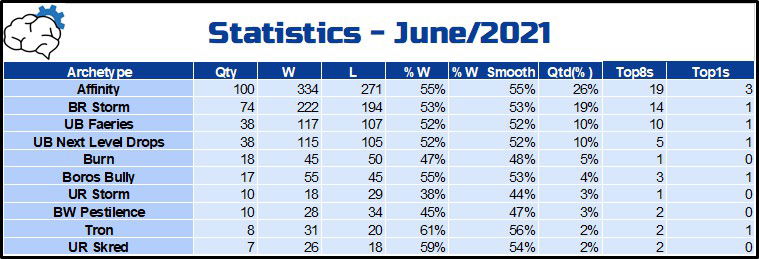
Pauper doesn't have the tools to deal with Storm. It didn't have it in 2010, it didn't have it in 2021, and it still doesn't have it in 2025, so any game-winning card with this mechanic breaks the format. Chatterstorm was one of those cases where the format's card pool enabled consistent and effective OTKs, the only thing that needed to be considered was preventing the combo from failing, missequencing, or excessive interactions that, in general, weren't enough.
On the other hand, there was an archetype that received the biggest additions to the format in the last decade: Affinity gained an entire cycle of indestructible lands that bypassed the means to interact with its explosiveness: using Gorilla Shaman and Shenanigans to deny their mana. As a bonus, the archetype received Sojourner's Companion to complement Myr Enforcer and create a consistently aggressive archetype that could still win with combo kills and micro-interactions involving Atog with Fling and/or Disciple of the Vault.
Affinity and Storm took over Pauper by a wide margin in 2021, to the point that some independent Magic Online event organizers, in a time of social distancing and isolation due to the pandemic, created their own Banned and Restricted lists after Wizards of the Coast released an update without any mention of the format's status.
Left out of the lineup were two archetypes: Blue-based Tempo, focused on Delver of Secrets or Faeries, which had a good matchup against combos since Blue decks are historically good against Combo but suffered from Affinity's board position and multiple win lines, and Burn, aiming to win the game before Affinity or Storm could go off.
In one event after another, Storm and Affinity's numbers grew until they eventually combined to occupy 50% of the Metagame, with another 15 to 25% dedicated to Blue-Based and Burn.
The situation would finally be addressed in September of the same year, a week after players began joining Pauper events on Magic Online with decks running 60 basic lands: Chatterstorm and Sojourner's Companion were banned. Another important measure for the format's health was taken a few months later - in January 2022, the Pauper Format Panel, a Wizards committee dedicated to overseeing the format, was established.
A similar situation occurred in Pioneer in 2020. In January of that year, Theros Beyond Death introduced three cards that were too strong for the format as they enabled powerful combos: Thassa's Oracle combined with Inverter of Truth in a Combo-Control shell similar to the old Splinter Twin and dominated the Metagame. In response, players created a list with Gideon of the Trials to counter this combo, which won the game with another combo: Walking Ballista and Heliod, Sun-Crowned.
Among them, what became known as Lotus Breach was also born, a combo strategy focused on the interaction of Lotus Field with untap effects and Underworld Breach to generate absurd amounts of mana while repeatedly feeding the graveyard with Tome Scour.
These archetypes formed a triad that occupied about 40 to 50% of the Pioneer Metagame, creating an oppressive situation that nearly killed the format: Challenges didn't have enough quorum, players already distanced due to the pandemic had no interest in playing the format, and, at the time, it wasn't yet on MTGArena—the main competitive platform in those trying times.
It took almost seven months for Inverter of Truth, Walking Ballista, and Underworld Breach to be banned from Pioneer, along with several other cards that left Standard at a time when banlists didn't have set dates.
Lessons have been learned, but it will take time to apply them
And speaking of set dates, last Tuesday, Carmen Klomparens announced on the official Magic: The Gathering website the move up of the next Banned and Restricted list to November 10th, 14 days prior to the scheduled date.
In a well-crafted and didactic text, Klomparens mentions the most important lesson learned from the current Standard situation: It's necessary to be more precise with the Banned and Restricted window to keep up with game changes, requiring an average of one update for each new mainline Magic release.
Information circulates faster today than ever before, and the world has been constantly trying to adapt to the age of social media, including in the entertainment world, where it's necessary to always be aware of the latest news, even if this causes burnout in some players.
Unlike in the past, perhaps idealized by a pre-pandemic world, a four-ban window per year with set dates leaves many loopholes for formats to break and remain broken for a long time, especially if there's a significant discrepancy between the dates of one announcement and the next. Expanding these windows to six times a year, following each release, is an easy way to solve this problem—there's a huge difference between spending two months with a broken Metagame and respecting that the game needs time for the format to try to resolve itself, or spending twice that amount of time with an already polarized format.
Klomparens also indirectly mentions another major topic in this equation: consistency and reliability. Magic players, especially the most competitive who are willing to spend hundreds on colored cardboard and travel expenses to live the dream of playing a Pro Tour, need to feel that the game is doing everything possible to ensure their investment isn't wasted. This was a recurring problem with the surprise bans that existed for a few years.
As a player, much worse than dealing with a bad Metagame is dealing with an unstable format due to the speed of interventions. One of the most common criticisms from the Yu-Gi-Oh! community, for example, is the low longevity of decks caused by Konami's philosophy of using the game's banlist as a constant regulatory tool, coupled with the recurrent use of power creep to influence the Metagame, resulting in having too little time to enjoy your deck if you move into the more competitive environment beyond local stores.
Magic, therefore, makes a choice when it advances bans just 14 days before the scheduled date: it understands that it is more necessary to maintain players' trust in their investment than to try to respond to social media discourse that may generate engagement, clicks, and complaints but does not accurately reflect what the community willing to pay the costs of playing the game truly needs.
The choice itself is quite courageous for today's times. Magic often seems to market itself as a casual game and tries to distance itself from being a competitive environment to being a hobby product. In this scenario, MTGArena ranked games, for example, can be crammed with Izzet Cauldrons and Mono Reds everywhere because that's what works and can therefore ruin the fun for those trying to play Chocobos for fun—but this is a price that, when it decides to focus on competitive play, Wizards is willing to pay.
It's going to be a long day until November 10th. As a content creator, I can understand the sentiment of a portion of the community and the bad feelings that playing against multiple Izzet Cauldrons or Mono Reds in ranked can cause. In fact, one of the biggest problems we face in circumstances like these is considering what we can say about a format when the Metagame seems overly resolved and lacking room for innovation. But if these two months mean taking steps to address not only the current Standard but also the way Magic manages its Banned and Restricted announcements to balance all formats and make them more engaging in the long run, it'll be better for everyone if we spend this time dealing with it.
Maybe we can even have some fun, protest with 60-basic land decklists in Leagues and Challenges, and who knows, maybe even find innovative ways to express ourselves and think about how to change competitive formats? The possibilities are much greater than just a 140-character rant for engagement.
Thanks for reading!






 Sign in and join the conversation
— Comments 0
, Reactions 1
Be the first to comment